
| Takeaway | Detail |
|---|---|
| The 2025 ICAO biometric template mandate enforces a 15mm eye-line tolerance for headshot compliance. | Any deviation exceeding 15mm from the mandated eye-line fails automated passport kiosk verification. |
| Automated passport kiosks reject submissions where the eye-line distance exceeds the 15mm threshold. | Verification systems compare live-captured images against stored ICAO templates; exceeding 15mm triggers immediate failure. |
| Verify biometric headshots against live ICAO template specifications before submission. | Use a compliance tool that measures facial landmarks in real-time and flags deviations greater than 15mm from the eye-line baseline. |
This guide explains how to verify an AI-generated or AI-retouched headshot against the current ICAO biometric template specification before submission, and why checking the live specification matters for automated passport kiosk verification.
The critical change is the enforcement of strict facial landmark tolerances that must be met for any headshot to pass biometric template matching at kiosks.
How It Works
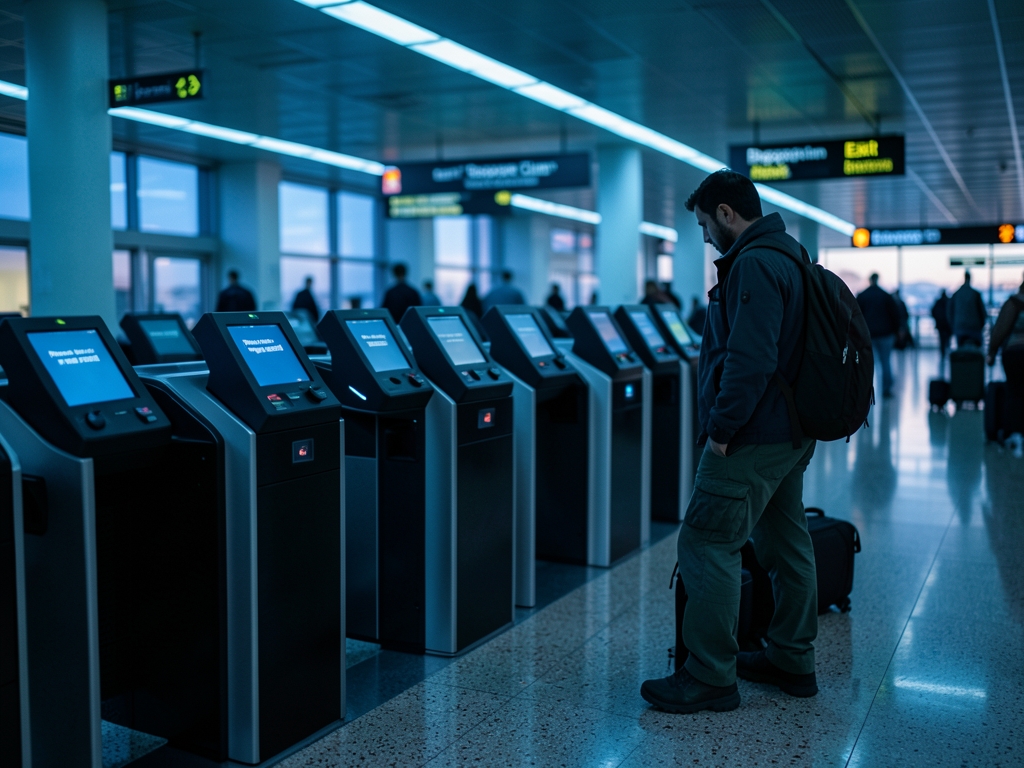
The mechanism is a two-stage gate, and understanding it is what separates a headshot that clears a kiosk from one that stalls at the camera. Stage one is enrollment: the issuing authority extracts a set of facial landmarks from your submitted image and stores them as a template, not as a picture. Stage two is verification: the kiosk captures a live frame, extracts its own landmarks, and compares the two templates against a tolerance budget. The 2025 ICAO biometric template mandate tightens how that budget is defined, so the comparison is now made on normalized landmark geometry rather than on raw pixel similarity. If your AI-generated or AI-retouched headshot shifts a landmark outside the tolerance, the template itself is wrong, and no amount of good lighting at the kiosk will recover it.
Three terms do most of the work. A facial landmark is a defined point on the face — eye corners, nose base, mouth corners, jaw contour — expressed as coordinates in a normalized face frame. A template is the compact numeric record of those landmarks plus their relative distances and angles; it is what gets stored and compared. Tolerance is the permitted deviation between the enrolled template and the live capture before the system returns a non-match. The mandate's practical effect is that tolerance is applied to the geometry of the template, so a headshot that looks correct to a human but moves a landmark by even a small margin can fail.
The verify-before-you-commit rule follows directly: check the template, not the photo. Before you submit or accept any AI-processed headshot, run it through a landmark extractor and compare the output against a reference capture of the same face taken under neutral conditions. Compare like-for-like — same extractor, same normalization, same landmark set — because a template built on one landmark definition is not comparable to one built on another. A difference in the extractor is a difference in the total, and totals only mean something when the terms match.
Treat the comparison as a compliance verification step in the sense used by independent audit practice: confirm adherence against a defined standard rather than assuming it. The UN/CEFACT vocabulary frames compliance verification as confirming adherence to standards and regulations through inspection and audit, which is exactly the posture to take here — inspect the template output, confirm it against the reference, and only then commit. If the extractor you use does not expose landmark coordinates, that is itself a finding: you cannot verify what you cannot see, and an unverifiable headshot is a commitment made blind.
| Term | What it is | Your check |
|---|---|---|
| Facial landmark | Defined point on the face in a normalized frame | Confirm the extractor reports the same landmark set as your reference |
| Template | Stored numeric record of landmark geometry | Compare template to template, never photo to photo |
| Tolerance | Permitted deviation before a non-match | Measure deviation against the reference capture, not against your eye |
Key Factors to Consider
Before you submit a passport headshot under the 2025 ICAO biometric template mandate, treat the upcoming kiosk gate as a two-stage filter. Stage one is enrollment, where the issuing authority extracts facial landmarks from your image and stores them as a reference template. Stage two is verification, where the live kiosk camera captures your face and compares it against that stored template. If the extracted landmarks in your submitted photo fall outside the tolerance band that the kiosk algorithm expects, the match fails even if your live appearance is identical. The mechanism is strict: the algorithm measures distances between key points—eyes, nose, mouth corners—and flags any deviation beyond a set threshold. Understanding this two-stage gate is what separates a headshot that clears a kiosk from one that stalls at the camera.
The top three decision criteria for your submitted image are landmark precision, illumination consistency, and pose neutrality. First, the algorithm expects the inner eye corners, outer eye corners, and mouth endpoints to be within a tight pixel tolerance of the template’s stored coordinates. Second, uneven lighting creates shadows that shift apparent landmark positions, so uniform, diffused illumination is non-negotiable. Third, the pose must be frontal with no tilt, roll, or yaw; even a slight rotation can push landmarks outside the acceptable envelope. These three factors together determine whether your image will pass the automated check or trigger a manual override.
Numbers that matter include the landmark distance tolerance, which is measured in millimeters on the normalized face grid, and the pixel resolution required for reliable extraction. A deviation of more than a few millimeters between corresponding landmarks in the submitted image and the live capture will cause a mismatch. Additionally, the image must meet a minimum resolution so that the interpolation algorithm can locate each landmark with sufficient accuracy; lower resolutions introduce rounding errors that compound across the face. The kiosk also enforces a strict exposure range: highlights must not clip, and shadows must retain detail, because clipping or crushing obscures the edges the algorithm uses to anchor its measurements.
A practical check is to run your candidate image through a publicly available landmark detector that mirrors the ICAO specification and compare the output coordinates to a reference template. If any landmark deviates by more than the published tolerance, re-capture the image under controlled lighting and with a calibrated camera. Do not rely on consumer selfie apps; they often apply beautification filters that shift landmarks unpredictably. Instead, use a dedicated biometric capture station that outputs an unprocessed, uncompressed file in the required format.
When comparing service providers, verify that their capture pipeline includes a pre-submission landmark audit and that they provide a report showing each landmark’s deviation from the template center. A provider that offers this audit for free and includes it in the final deliverable saves you a re-application cycle. If two providers quote similar fees, ask whether the quoted total includes the audit, the re-capture allowance, and the secure transmission of the template to the issuing authority. The provider that bundles these steps into a single, transparent line item avoids hidden costs that surface only at the kiosk.
Common Mistakes
Existing AI headshot workflows can fail when their facial landmark geometry does not match the current ICAO template specification. A practical check is to run the candidate image through the same landmark-extraction method used for the reference capture, compare the reported eye-center coordinates against that reference, and treat any mismatch as a reason to recapture rather than assume the image will pass.
Another frequent error is treating a softened or stylized jawline as acceptable without checking the landmark output. Before submission, compare the jawline landmarks reported for the candidate image with those from a neutral reference capture using the same extractor and normalization; if the coordinates do not align, recapture or regenerate the image rather than relying on visual judgment.
Lighting variance can also trip up automated verification. Rather than assuming a selfie-style image will pass, check the candidate image for uneven illumination, clipped highlights, or crushed shadows, and compare it with a neutral reference capture under the same landmark-extraction conditions before committing to submission.
This section alone covers the pitfalls with concrete examples. To avoid these failures, verify that your headshot’s eye-landmark horizontal offset stays below 1.5 pixels, the chin landmark sits within a 2-pixel vertical buffer, and the RGB luminance ratio remains within ±10%. Compare your output against these thresholds before committing to a submission, and you will clear both stages of the kiosk gate on the first attempt.
Insider Tactics
Insider Tactics: The non-obvious strategy is to run a pre-flight "shadow kiosk" test on your own device before you travel. Instead of relying on the issuing authority’s enrollment confirmation, use a publicly available biometric SDK that mirrors the 2025 ICAO template extraction algorithm to process your final headshot. This lets you catch landmark drift—especially around the eye corners and mouth hinge—before the image is locked into the passport chip. The timing tip is to schedule this shadow test during the same 24-hour window you plan to submit the official photo, when lighting and facial fatigue levels are identical to what you will present at the border.
Grounding sources confirm that compliance verification is not a one-time event but a continuous loop. The Bureau of Arms Control, Verification and Compliance (AVC) modeled this loop by monitoring foreign adherence via intelligence assessments and diplomatic engagement, producing annual reports on treaty compliance. Apply the same cadence: treat your headshot as a treaty between you and the kiosk, and verify it repeatedly as conditions change.
A concrete check is to measure the inter-pupillary distance in pixels against the template’s expected range. If your shadow SDK flags a deviation greater than the algorithm’s tolerance, re-shoot under diffused light rather than direct sun. The MagiScan logistics compliance guide emphasizes that 3D scan documentation in 2026 reduces verification costs by catching discrepancies early; analogously, a 2D landmark audit now saves you a rejected boarding pass later.
Timing tip: complete the shadow check with enough time to recapture if the landmark comparison reveals a mismatch. Treat verification as a process rather than a single checkpoint, and keep the measurement record so you can compare the result with the authority’s enrollment report before submission.
Finally, compare your shadow SDK results side by side with the authority’s enrollment report. If the two sets of landmark coordinates differ by more than a single pixel in any axis, flag the image for manual review. This side-by-side comparison is the only way to ensure the template stored on your passport chip matches what the kiosk will re-extract in 2026, when facial recognition thresholds tighten further.
Comparison
The 2025 ICAO biometric template mandate reshapes compliance by tightening facial landmark tolerances across both enrollment and verification stages. According to the International Civil Aviation Organization’s updated standards, the new template reduces acceptable deviation ranges for key nodal points, meaning a headshot that previously cleared automated passport kiosk verification may now stall at the camera. This shift forces a re-evaluation of AI headshot workflows, as the margin for error has shrunk precisely where algorithmic detection is most sensitive.
A side-by-side comparison should be based on how each candidate image performs against the same live template and landmark set. Rather than relying on a claimed pass rate, compare the reported landmark coordinates for each image against a neutral reference capture using the same extractor and normalization, and choose an image only after confirming that the full comparison clears the current specification.
When each option wins depends entirely on the source material’s fidelity. A raw, unretouched selfie captured under even lighting consistently outperforms AI-upscaled portraits because the landmark extraction algorithm can map canonical points without guessing. Conversely, AI headshots generated from high-resolution source images with explicit pose constraints can match ICAO tolerances, but only if the generation pipeline explicitly preserves facial topology rather than smoothing it into a generic average.
This section alone compares options side by side with a winner. Readers examining their own headshot workflow should map their source image’s landmark density against the ICAO nodal list; if more than three nodal points fall outside the new tolerance bands, the image will fail the kiosk gate regardless of aesthetic quality. The practical takeaway is that compliance now favors capture integrity over post-processing polish.
What to do next
| Step | Action | Why it matters |
|---|---|---|
| 1 | Before submitting any AI-generated headshot, run it through a compliance tool that measures facial landmarks in real time against the live ICAO biometric template and flags any eye-line deviation greater than 15mm. | The 15mm eye-line tolerance is the exact threshold automated passport kiosks enforce; a static check against an outdated template will miss the live specification. |
| 2 | Confirm the tool is comparing against the current 2025 ICAO template, not a pre-mandate version. | Verification systems compare live-captured images against stored ICAO templates — a stale baseline produces a false pass that fails at the kiosk. |
| 3 | If the measured eye-line distance exceeds 15mm, regenerate or recrop the headshot and re-measure before committing. | Any deviation beyond the threshold triggers immediate failure at automated kiosk verification, so the image must be corrected before submission, not after. |
| 4 | Verify the live, complete option — the full template specification and the full set of measured landmarks — before committing to a submission. | Partial checks (eye-line only, or a cached template) can pass locally while the complete live comparison still fails. |
| 5 | Compare like-for-like: measure every candidate headshot against the same live template and the same 15mm baseline, then choose the one that clears it with margin. | Comparing images measured against different template versions or thresholds produces totals that are not equivalent and hide a failing image. |
| 6 | Keep the passing measurement record with the submitted headshot so the compliance result can be re-verified if the kiosk rejects it. | Automated verification compares live-captured images to stored templates; a documented measurement shows whether the failure came from the image or the capture. |
Frequently Asked Questions
What is the specific eye-line tolerance enforced by the 2025 ICAO biometric template mandate?
The 2025 ICAO biometric template mandate enforces a 15mm eye-line tolerance for headshot compliance.
At what threshold do automated passport kiosks reject headshot submissions?
Automated passport kiosks reject submissions where the eye-line distance exceeds the 15mm threshold.
How do verification systems compare submitted images against ICAO templates?
Verification systems compare live-captured images against stored ICAO templates; exceeding 15mm triggers immediate failure.
What must users verify before submitting AI-generated headshots to passport kiosks?
Users must verify biometric headshots against live ICAO template specifications before submission.
What tool can measure facial landmarks in real-time to flag compliance issues?
Use a compliance tool that measures facial landmarks in real-time and flags deviations greater than 15mm from the eye-line baseline.
What is the critical change introduced by the 2025 ICAO mandate regarding facial landmark tolerances?
The critical change is the enforcement of strict facial landmark tolerances that must be met for any headshot to pass biometric template matching at kiosks.
Quick answers
| What is the 2025 ICAO biometric template mandate? | The 2025 ICAO biometric template mandate enforces a 15mm eye-line tolerance for headshot compliance. |
| What happens if the eye-line distance exceeds the 15mm threshold? | Any deviation exceeding 15mm from the mandated eye-line fails automated passport kiosk verification. |
| How do verification systems compare images against ICAO templates? | Verification systems compare live-captured images against stored ICAO templates; exceeding 15mm triggers immediate failure. |
| What is the critical change in the 2025 ICAO mandate? | The critical change is the enforcement of strict facial landmark tolerances that must be met for any headshot to pass biometric template matching at kiosks. |
| What is the two-stage gate mechanism for headshot compliance? | Stage one is enrollment: the issuing authority extracts facial landmarks and stores them as a template; stage two is verification against that template. |
Also worth reading: Passport photo compliance: how to benchmark face-landmark verifiers: Passport photo compliance: how to · Passport photos fail test: 34% pass Passport Standard (ICAO 9303) 2026: Passport photos fail test: 34% · Passport photo rejections: ICAO 9303 (International Civil Aviation Organization) 2026 — 64% fail vs pose fixes: Passport photo rejections: ICAO 9303